Author: : Sajad Khodadadi
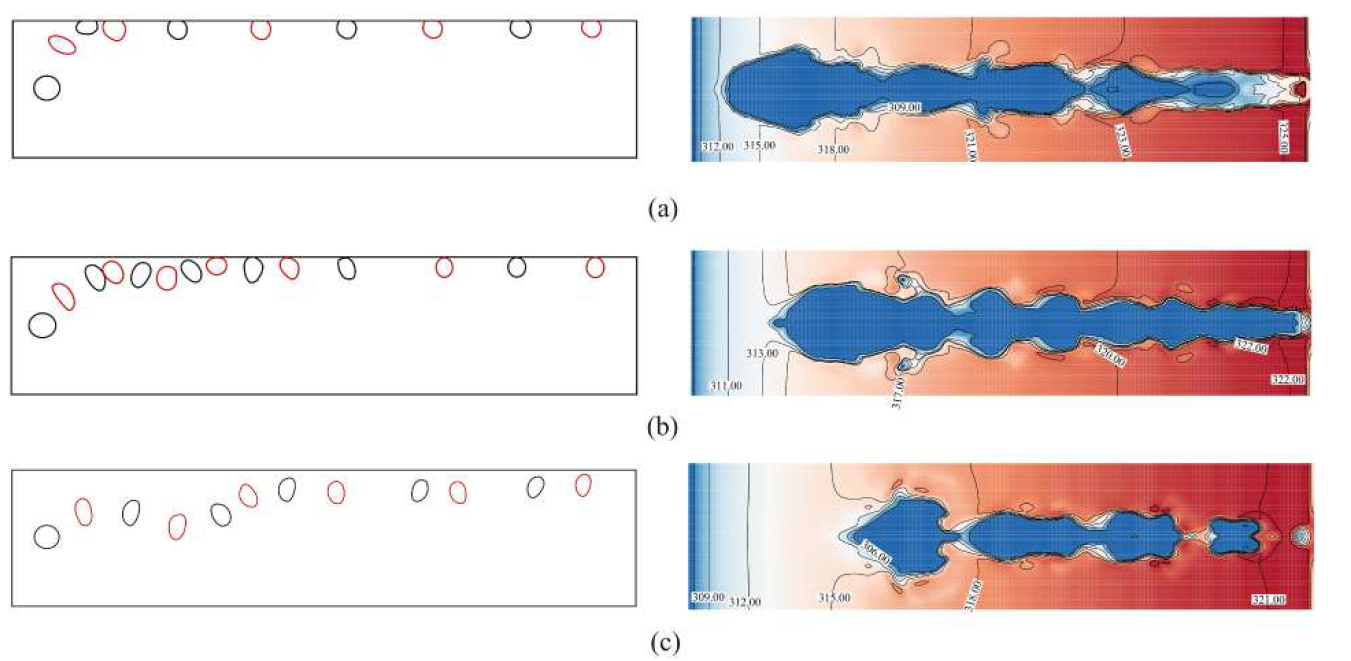
In this numerical study, the effect of bubble injection on the heat transfer rate near an inclined heated wall is investigated. The Volume of Fluid (VoF) method is extended with an energy equation and Boussinesq approximation to consider natural convection. The results show maximum heat transfer at a 60° wall slope. Bubble interactions, including coalescence and bouncing, are analyzed under various conditions. The Nusselt number is enhanced up to 92% in intermittent contact regimes.
Heat transfer enhancement using bubble dynamics is critical in industries such as cooling systems and heat exchangers. This study focuses on the mechanisms behind the heat transfer improvement via bubble motion near inclined walls. Previous research has shown that bubble impingement or sliding can significantly increase convective heat transfer. This work uses numerical methods to further investigate these phenomena.
The governing equations include the continuity, Navier-Stokes, and energy equations. The VoF method is used to track the gas-liquid interface, and the Boussinesq approximation models natural convection. The simulations are performed using OpenFOAM’s interFoam solver.
The computational domain consists of a channel with heated walls, where a bubble is injected at different wall slopes. Parameters such as contact angle, Bond number, and bubble regimes are varied to study their impact on heat transfer. Grid independence is verified using the Grid Convergence Index (GCI) method.
The simulations reveal that heat transfer is enhanced by bubble injection, with a maximum Nusselt number observed at a wall slope angle of 60°. The effect of various parameters, such as Bond number and contact angle, is explored, and the results are validated against previous studies.
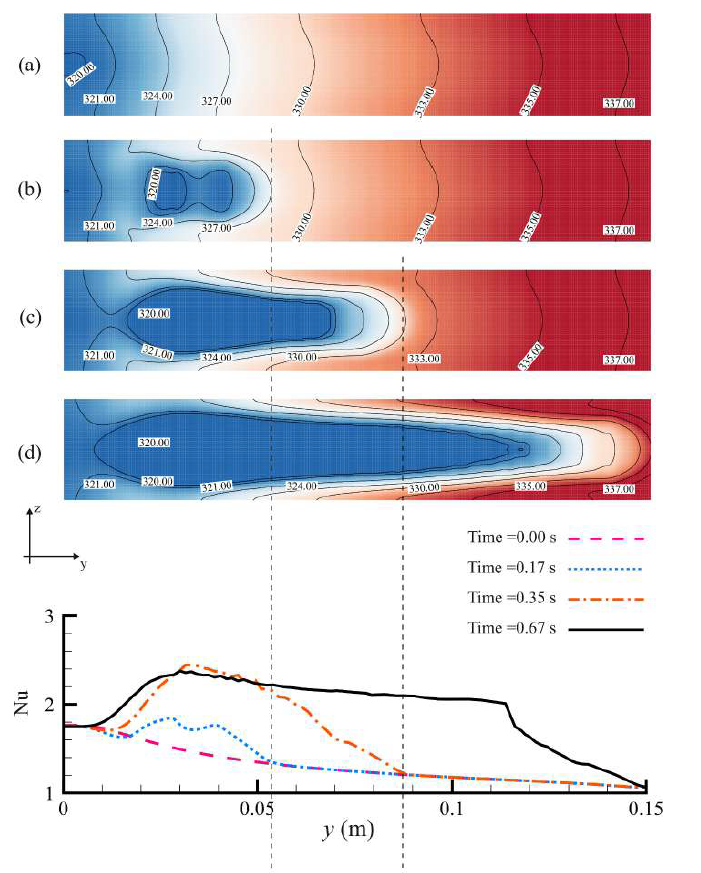
This study presents a detailed investigation of heat transfer enhancement via bubble dynamics along an inclined wall. The results indicate that the bubble's impact on the thermal boundary layer significantly increases the Nusselt number, particularly in the intermittent contact regime. Future work could explore more complex geometries and 3D simulations.